
Automotive HMI Market to Reach USD 70.5 Billion by 2035, Growing at 9.6% CAGR
According to a study from Market Research Future, Automotive HMI Market projected to reach USD 70.5 Billion, at a CAGR
Press Release Disclaimer: This is a press release distributed through the XPR Media network. It has not been independently verified by our newsroom.
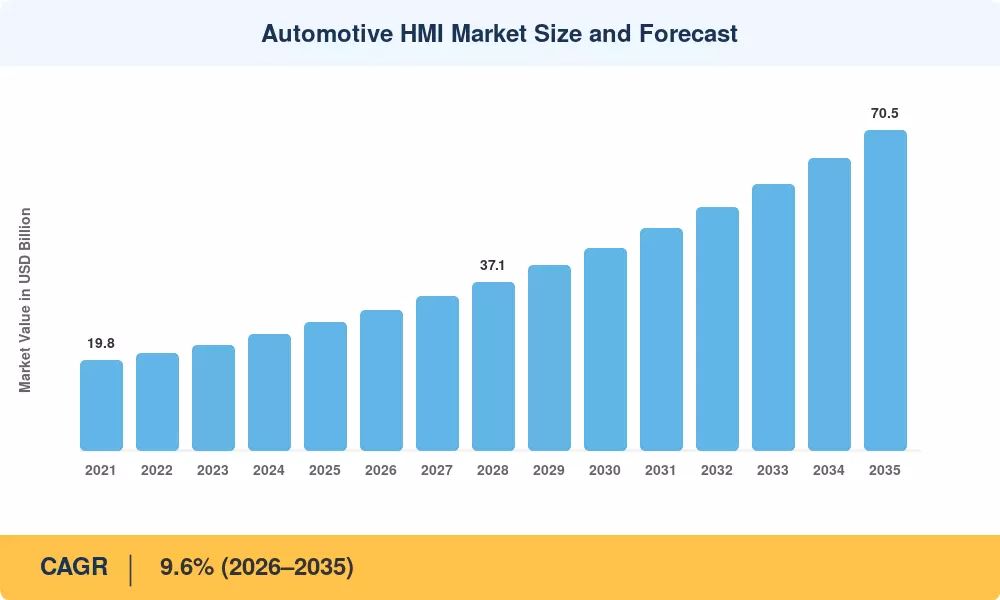

According to a study from Market Research Future, Automotive HMI Market projected to reach USD 70.5 Billion, at a CAGR of 9.6% during 2026 to 2035.
NEW YORK, NY, UNITED STATES, August 21, 2026 /EINPresswire.com/ — Automotive HMI Market to Reach USD 70.5 Billion by 2035, Growing at 9.6% CAGR
According to a study from Market Research Future, Automotive HMI Market projected to reach USD 70.5 Billion, at a CAGR of 9.6% during 2026 to 2035, driven by Integration of advanced artificial intelligence in Automotive HMI systems enhances user experience and safety.
Market Overview
The Automotive Human-Machine Interface (HMI) Market represents one of the most dynamic and rapidly evolving segments within the global automotive industry. Automotive HMI encompasses all hardware and software components that facilitate interaction between vehicle occupants and the vehicle’s systems, including displays, touchscreens, voice recognition systems, gesture control interfaces, and haptic feedback mechanisms. These systems serve as the critical bridge between drivers, passengers, and the increasingly complex array of vehicle functions, from navigation and entertainment to climate control and advanced driver assistance systems.
The market’s robust growth trajectory is underpinned by several key drivers. The accelerating shift toward electric and autonomous vehicles has fundamentally transformed the role of HMI systems, moving beyond basic controls to become central components of the vehicle experience. The integration of advanced artificial intelligence in Automotive HMI systems enhances user experience and safety by enabling predictive personalization, adaptive interfaces, and intelligent voice assistants that learn driver preferences and behavior patterns. Additionally, the growing consumer expectation for smartphone-like connectivity and seamless digital experiences within vehicles has pushed automakers to invest heavily in sophisticated display technologies and intuitive interface designs.
Several significant industry trends are shaping the Automotive HMI landscape. The transition from traditional button-based controls to digital interfaces continues to gain momentum, with manufacturers increasingly adopting large-format displays, curved screens, and even pillar-to-pillar display panels that span the entire dashboard. The convergence of HMI with advanced driver assistance systems represents another crucial trend, where visual and auditory alerts work in harmony to enhance driver awareness and reduce cognitive load. The rise of software-defined vehicles has also enabled over-the-air updates, allowing manufacturers to continuously refine and improve HMI functionality throughout the vehicle’s lifecycle.
Technological developments are occurring at a rapid pace within the Automotive HMI sector. OLED and Micro-LED display technologies are gaining traction due to their superior contrast ratios, energy efficiency, and flexibility in design applications. Augmented reality head-up displays are emerging as a game-changing technology, projecting navigation guidance and safety information directly onto the windshield, creating an immersive and intuitive driving experience. Gesture recognition systems, powered by sophisticated sensors and machine learning algorithms, are becoming more accurate and responsive, allowing drivers to control various functions with simple hand movements without taking their eyes off the road.
Government policies and regulatory frameworks are exerting significant influence on Automotive HMI development. Safety regulations in major markets such as North America and Europe mandate minimum performance standards for displays and require that critical information be accessible without causing driver distraction. These regulations have spurred innovation in areas such as voice control and head-up displays, which allow drivers to access information while maintaining visual contact with the road. Additionally, government initiatives promoting electric vehicle adoption have indirectly accelerated HMI development, as EVs often feature more advanced digital cockpits to differentiate from internal combustion engine vehicles.
The demand outlook for Automotive HMI systems remains exceptionally strong, driven by the increasing penetration of advanced display technologies across all vehicle segments. While luxury vehicles have traditionally led the adoption of sophisticated HMI systems, mid-range and economy vehicles are rapidly incorporating similar technologies as costs decrease and consumer expectations rise. The commercial vehicle segment is also emerging as a significant growth area, with fleet operators seeking enhanced driver comfort, improved safety, and better operational efficiency through advanced HMI solutions.
📍 Get Free Sample Report for Detailed Market Insights:
https://www.marketresearchfuture.com/sample_request/2358
Market Segmentation
The Automotive HMI Market is comprehensively segmented to provide detailed insights into the various aspects of this dynamic industry.
By Technology: The market encompasses Visual Displays including TFT-LCD, OLED, and Micro-LED technologies, each offering distinct advantages in terms of resolution, power consumption, and design flexibility. Voice Recognition systems are gaining prominence as hands-free control becomes increasingly important for safety and convenience. Instrument Clusters, particularly Digital instrument clusters, are replacing traditional analog gauges with customizable, high-resolution displays. Head-Up Displays (HUD) are experiencing rapid adoption, providing critical information directly in the driver’s line of sight. Haptic and Tactile Feedback systems enhance user interaction by providing physical confirmation of inputs, improving usability without requiring visual attention. Gesture Recognition technology enables intuitive control of vehicle functions through natural hand movements, representing a frontier of HMI innovation.
By Vehicle Type: The market is categorized into Passenger Vehicles, Light Commercial Vehicles, and Heavy Commercial Vehicles. Passenger vehicles constitute the largest segment, driven by consumer demand for connected, convenient, and safe driving experiences. Light commercial vehicles are increasingly incorporating advanced HMI to improve driver productivity and fleet management. Heavy commercial vehicles are adopting HMI solutions focused on driver assistance, safety compliance, and operational efficiency.
By Access Type: The market is segmented into Standard (Single-Mode Input) and Multimodal (Combined Input) systems. Standard systems rely on a single input method such as touch or voice, while multimodal systems combine multiple input methods to offer more flexible and intuitive user experiences. Multimodal systems are gaining traction as they allow drivers to choose the most appropriate interaction method based on context and preference.
🛒 You can buy this market report at:
https://www.marketresearchfuture.com/checkout?currency=one_user-USD&report_id=2358
Regional Analysis
North America represents a significant market for Automotive HMI, driven by high consumer acceptance of advanced vehicle technologies, strong presence of major automotive manufacturers and technology companies, and favorable regulatory frameworks promoting vehicle safety. The United States leads the region, with consumers showing strong preference for vehicles equipped with large displays, smartphone integration, and advanced driver assistance features. The presence of technology giants in Silicon Valley has fostered innovation in automotive interfaces, with many companies establishing research centers focused on next-generation HMI solutions.
Europe holds a substantial share of the Automotive HMI market, benefiting from the presence of premium automotive manufacturers that have historically been at the forefront of interior technology innovation. German automakers, in particular, have invested heavily in developing sophisticated display and control systems that set industry benchmarks. The region’s stringent safety regulations have accelerated the adoption of head-up displays and voice recognition systems that minimize driver distraction. Additionally, European consumers’ strong emphasis on design and quality has driven investment in high-resolution displays and premium materials for HMI components.
Asia-Pacific is poised to experience the most rapid growth in the Automotive HMI market, driven by the region’s dominant position in global automotive production and the rapid expansion of electric vehicle manufacturing. China, Japan, and South Korea are leading the charge, with Chinese EV manufacturers particularly active in incorporating cutting-edge HMI technologies that often surpass those found in traditional luxury vehicles. The region’s technology-savvy consumer base has created strong demand for connected vehicle features, voice assistants, and advanced navigation systems. Furthermore, the presence of major display and semiconductor manufacturers in the region ensures a robust supply chain for HMI components.
Rest of the World, including Latin America, the Middle East, and Africa, represents emerging markets with substantial growth potential. While currently accounting for a smaller share of the global market, these regions are witnessing increasing adoption of advanced HMI technologies as vehicle manufacturers introduce models with sophisticated interfaces to capture discerning consumer segments. Economic development, urbanization, and improving infrastructure are contributing to market expansion in these regions.
Competitive Landscape
The Automotive HMI market features intense competition among a diverse array of players, including established automotive suppliers, technology companies, and specialized HMI developers. Key companies in this space include Continental AG, Bosch, Denso Corporation, Visteon Corporation, Panasonic Automotive Systems, Hyundai Mobis, Valeo, Harman International, Clarion, and Garmin, among others. These companies compete on factors including technological innovation, product quality, integration capabilities, pricing, and relationships with automotive manufacturers.
Strategic developments in the market have been characterized by a focus on innovation and collaboration. Major suppliers have been investing heavily in research and development to create integrated HMI solutions that combine multiple technologies into cohesive packages. The shift toward centralized computing architectures in vehicles has prompted companies to develop domain controllers that consolidate various HMI functions into single processing units, reducing complexity and cost while improving performance.
Market positioning varies significantly among players. Some companies focus on specific HMI technologies, such as display manufacturing or voice recognition, while others offer comprehensive solutions spanning multiple technology areas. The trend toward digitalization and software-defined vehicles has encouraged HMI suppliers to develop capabilities in software development and user experience design, moving beyond pure hardware supply to become technology partners for automotive manufacturers.
Latest Industry News & Developments
Recent developments in the Automotive HMI industry highlight the rapid pace of innovation and the strategic moves by major players. Leading automotive suppliers have announced significant investments in next-generation display technologies, including flexible OLED screens and transparent displays that can be integrated into various vehicle surfaces. Companies are also forming strategic partnerships with technology firms to enhance AI capabilities in voice recognition and predictive user interfaces.
The trend toward larger, more integrated displays continues to accelerate, with several automakers unveiling production vehicles featuring screens that span the entire dashboard width. These displays often incorporate multiple zones for instrument cluster, infotainment, and passenger entertainment functions, requiring advanced HMI software to manage content delivery and user interaction across different display areas.
Another notable development is the emergence of biometric authentication and personalization features within HMI systems, allowing vehicles to automatically adjust settings based on driver identification through fingerprint scanning, facial recognition, or voice recognition. This personalization extends to seat and mirror positions, climate preferences, infotainment content, and driving mode selections, creating a truly customized experience.
Market Challenges & Opportunities
Despite the strong growth prospects, the Automotive HMI market faces several challenges. The complexity of integrating multiple technologies into cohesive systems requires significant engineering effort and substantial investment in software development. Cybersecurity concerns associated with connected vehicle interfaces present ongoing challenges, as HMI systems represent potential entry points for malicious actors. Additionally, the rapid pace of technological advancement means that HMI systems risk becoming outdated quickly, creating challenges for automakers in terms of product lifecycle management and consumer satisfaction.
However, these challenges are accompanied by substantial opportunities. The transition to electric vehicles presents a unique opportunity for HMI innovation, as EV manufacturers often start from a clean sheet in designing vehicle interiors, allowing for more radical HMI approaches. The growing demand for autonomous driving features will create new HMI requirements, particularly in areas such as driver monitoring, take-over requests, and enhanced interior experiences during autonomous operation. Emerging markets offer significant growth opportunities as vehicle penetration increases and consumers in these regions demonstrate strong appetite for connected and technologically advanced vehicles.
To explore more market insights, visit us at:
https://www.marketresearchfuture.com/reports/automotive-hmi-market-2358
Final Market Summary
The Automotive HMI Market is on a clear growth trajectory, projected to reach USD 70.5 Billion by 2035 at a CAGR of 9.6%. This expansion reflects the fundamental transformation occurring in the automotive industry, where digital interfaces are becoming central to the vehicle experience. The integration of advanced AI, sophisticated display technologies, and multimodal interaction methods is creating more intuitive, safe, and enjoyable driving experiences.
The long-term industry potential remains extremely promising, driven by continued innovation in display technology, voice recognition, gesture control, and biometric identification. As vehicles become increasingly connected, automated, and electrified, the role of HMI will only expand, creating new opportunities for companies that can deliver compelling, innovative solutions.
Looking ahead, the market is expected to evolve significantly, with trends such as transparent displays, holographic projections, and brain-machine interfaces potentially becoming commercial realities. The competitive landscape will likely see increased collaboration between automotive suppliers and technology companies, as the boundaries between automotive and consumer electronics continue to blur. Sustainability considerations will also influence HMI development, with energy-efficient display technologies and sustainable materials gaining importance.
More Related Reports from MRFR Library:
Turbocharger Market : https://www.marketresearchfuture.com/reports/turbocharger-market-1835
Alloys for Automotive Market : https://www.marketresearchfuture.com/reports/alloys-for-automotive-market-1910
Heat Shield Market : https://www.marketresearchfuture.com/reports/heat-shield-market-2012
Vehicle Electrification Market : https://www.marketresearchfuture.com/reports/vehicle-electrification-market-2043
Automotive Telematics Market : https://www.marketresearchfuture.com/reports/telematics-in-automotive-market-2296
Smart Parking Market : https://www.marketresearchfuture.com/reports/smart-parking-market-2323
Automotive Axle Market : https://www.marketresearchfuture.com/reports/automotive-axle-market-2343
Car Wash System Market : https://www.marketresearchfuture.com/reports/car-wash-system-market-3863
Automotive Disc Brake Market : https://www.marketresearchfuture.com/reports/automotive-disc-brake-market-3954
Electric Axle Drive System Market : https://www.marketresearchfuture.com/reports/electric-axle-drive-systems-market-4082
Larry Wilson
WantStats Research And Media Pvt. Ltd.
+1 855-661-4441
email us here
Legal Disclaimer:
EIN Presswire provides this news content “as is” without warranty of any kind. We do not accept any responsibility or liability
for the accuracy, content, images, videos, licenses, completeness, legality, or reliability of the information contained in this
article. If you have any complaints or copyright issues related to this article, kindly contact the author above.

Media gallery

