
Mobisoft Infotech Launches AI-Native Modernization Services to Help Businesses Upgrade Their Legacy Software
The new approach combines AI-powered application discovery, code analysis, modernization, and testing with experienced
Press Release Disclaimer: This is a press release distributed through the XPR Media network. It has not been independently verified by our newsroom.
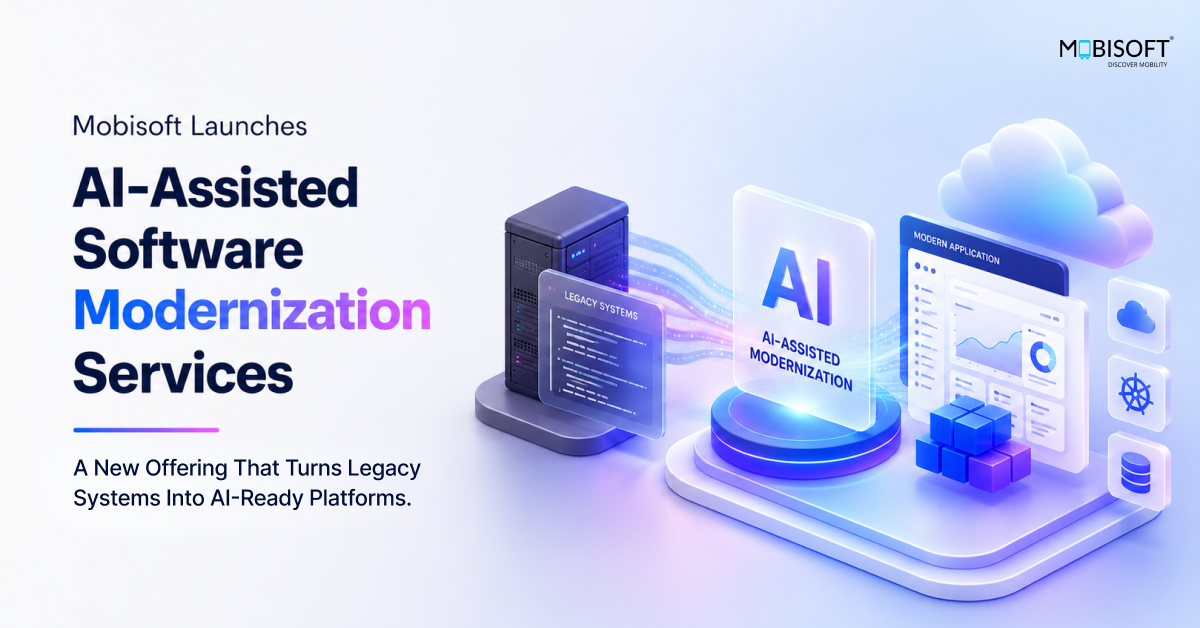

The new approach combines AI-powered application discovery, code analysis, modernization, and testing with experienced engineers to reduce transformation risk.
HOUSTON, TX, UNITED STATES, September 3, 2026 /EINPresswire.com/ — Mobisoft Infotech, an AI-native product engineering and software development company, today announced the launch of its AI-assisted legacy modernization services. It’s a new offering designed to help businesses upgrade aging software systems into platforms ready for artificial intelligence adoption. The service combines AI-powered product discovery, code analysis, modernization, and testing with experienced engineering teams to reduce risk and speed up transformation timelines.
For years, legacy software modernization has given businesses a real opportunity to unlock value trapped in aging systems, even though it has also ranked among the most difficult technology decisions they face. Organizations often know their aging applications need attention. The software may be expensive to maintain, difficult to integrate, dependent on outdated technologies, or increasingly hard to support as experienced developers retire or move on. Yet replacing these systems can be equally risky.
The reason is simple. Legacy applications often contain years, sometimes decades, of valuable business logic. That has traditionally made modernization a costly and time-consuming undertaking. A well-planned application migration and modernization can preserve that business logic while removing the constraints holding it back, but engineering teams first needed to understand large and often poorly documented codebases, identify dependencies, map business processes, and ensure that changes did not disrupt critical operations.
Artificial intelligence is beginning to change that equation.
AI Is Reducing the Discovery Challenge:
One of the biggest challenges in legacy modernization has always been understanding what already exists. In many organizations, the people who originally built critical systems are no longer with the company. Documentation may be incomplete or outdated, while important business rules remain buried deep within thousands or millions of lines of code.
AI-assisted engineering tools are now helping technology teams analyze codebases, identify dependencies, generate documentation, detect patterns, and support the understanding of complex applications significantly faster than traditional approaches.
Modernization Becomes More Accessible to Mid-Market Businesses:
Large enterprises have traditionally been better positioned to undertake multi-year modernization programs with significant budgets and large internal technology teams.
Mid-market organizations often face a more difficult situation. They may depend on mission-critical applications built years ago but lack the resources to fund a complete rewrite. As a result, modernization projects are frequently delayed until maintaining the existing system becomes increasingly expensive or risky.
AI-assisted development and modernization are beginning to change the economics. By accelerating activities such as application discovery, code analysis, documentation, testing and refactoring, AI can help engineering teams reduce the time required for some of the most labor-intensive stages of modernization.
That does not mean modernization can simply be automated. It still requires experienced people to make decisions.
The AI Readiness Problem:
The growing interest in artificial intelligence is also creating a new reason for companies to modernize. Many businesses want to introduce AI assistants, intelligent automation and AI agents into their operations. But these initiatives often depend on access to reliable data and connected systems.
Legacy applications can become a significant barrier. Older systems may have limited APIs, fragmented databases, outdated architectures, and disconnected workflows. Even when a company has identified valuable AI use cases, its underlying technology infrastructure may not be ready to support them.
This is creating a growing connection between legacy modernization and AI adoption. Before organizations can fully take advantage of AI, many first need to make their existing systems more accessible, connected, and scalable.
Industry research has repeatedly shown that a large share of enterprise IT budgets goes toward maintaining existing systems rather than building new capabilities. Analysts have long pointed out that many organizations spend the majority of their technology budgets simply keeping legacy applications running. That leaves limited room for innovation, including AI initiatives that leadership teams increasingly view as a competitive necessity.
For mid-market businesses, this tension is often sharper. Smaller IT teams mean less capacity to run parallel projects. A team maintaining a legacy application often has little bandwidth left to explore new AI use cases, even when leadership wants to move faster.
Mobisoft’s approach to AI-assisted discovery aims to directly address this bottleneck. Instead of requiring weeks or months of manual documentation review, the company’s AI-powered analysis tools scan codebases to map dependencies, flag outdated components, surface embedded business rules, and generate structured documentation. Engineering teams can then review these outputs and prioritize which parts of a system to preserve, refactor, or replace.
“Discovery used to be the slowest and most expensive part of any modernization project,” Ritesh Patil said. “Teams would spend months just trying to understand what a system actually did before they could make any real decisions. AI has compressed that timeline substantially, which changes what is realistically possible for a mid-market company.”
Modernize, Don’t Automatically Rebuild:
One of the biggest misconceptions around legacy technology is that every old application needs to be replaced. In reality, different applications require different strategies. Some may benefit from cloud migration. Others may need API enablement, user experience modernization, database upgrades, or selective refactoring. In certain cases, rebuilding may be the right decision.
The key is determining the right approach before significant investment is made. Mobisoft structures its engagements around this principle. Each modernization effort begins with an AI-assisted assessment phase, where automated analysis tools work alongside engineers to evaluate an application’s architecture, code quality, security posture and integration points. The output is a prioritized modernization roadmap rather than a single prescribed solution.
This approach allows businesses to sequence their investments. A company might choose to modernize a customer-facing module first, while leaving a stable backend system untouched until a later phase. Another might prioritize API enablement so that AI tools can safely access data trapped inside an older application, without undertaking a full rebuild.
A New Modernization Model:
As AI capabilities continue to evolve, software modernization is likely to become increasingly data-driven and intelligent.
AI can help teams understand complex applications faster. It can support documentation, identify potential issues, assist developers with refactoring, and generate testing scenarios. At the same time, experienced engineers remain essential for architectural decisions, security, compliance, and validating business-critical functionality. The result is a new model for modernization.
AI for Speed, Human Expertise for Judgment:
Mobisoft’s launch of these services reflects a broader shift happening across the technology industry. Vendors and service providers are increasingly building AI directly into engineering workflows, rather than treating it as a separate tool. For modernization specifically, this means faster assessments, more accurate testing, and a shorter path from initial analysis to deployed changes.
The company said its services are designed to scale across a range of engagement types, from targeted modernization of a single application to broader, multi-system transformation programs. Each engagement includes both AI-powered tooling and a dedicated engineering team responsible for validating changes before they reach production.
For mid-market businesses that have postponed modernization because of cost, complexity, or risk, this combination could create new opportunities. A project that once required a multi-year commitment and a large budget may now be achievable in a shorter timeframe, with more predictable outcomes.
The question may no longer be whether a company can afford to modernize its legacy software. The more important question may be whether it can afford to wait.
Availability:
Mobisoft’s AI-assisted legacy modernization services are now available to businesses worldwide across industries, including healthcare, financial services, logistics and retail. Engagements can begin with a standalone application assessment or a broader modernization roadmap, depending on a company’s needs and timeline.
Businesses interested in evaluating their legacy systems can request an initial assessment through Mobisoft Infotech’s website.
About Mobisoft Infotech:
Mobisoft Infotech is an AI-native digital transformation and technology solutions company helping businesses build, modernize, and scale software products. The company works across AI, cloud, web and mobile technologies, helping organizations transform complex technology challenges into scalable digital solutions. Its engineering teams support clients across healthcare, finance, logistics, retail and other industries, combining technical expertise with a practical, business-first approach to software development.
Ritesh Patil
Mobisoft Infotech
+1 855-572-2777
email us here
Visit us on social media:
LinkedIn
Instagram
Facebook
YouTube
X
Legal Disclaimer:
EIN Presswire provides this news content “as is” without warranty of any kind. We do not accept any responsibility or liability
for the accuracy, content, images, videos, licenses, completeness, legality, or reliability of the information contained in this
article. If you have any complaints or copyright issues related to this article, kindly contact the author above.

Media gallery

